SaaS vs AI is the wrong question to be asking
SaaS vs AI is a false fight. AI is an input to software, not a rival. Here is the layer model for how the two fit, and what to ship on top of your core.
 Shahriar P. ShuvoAI for SaaS & Features7 min read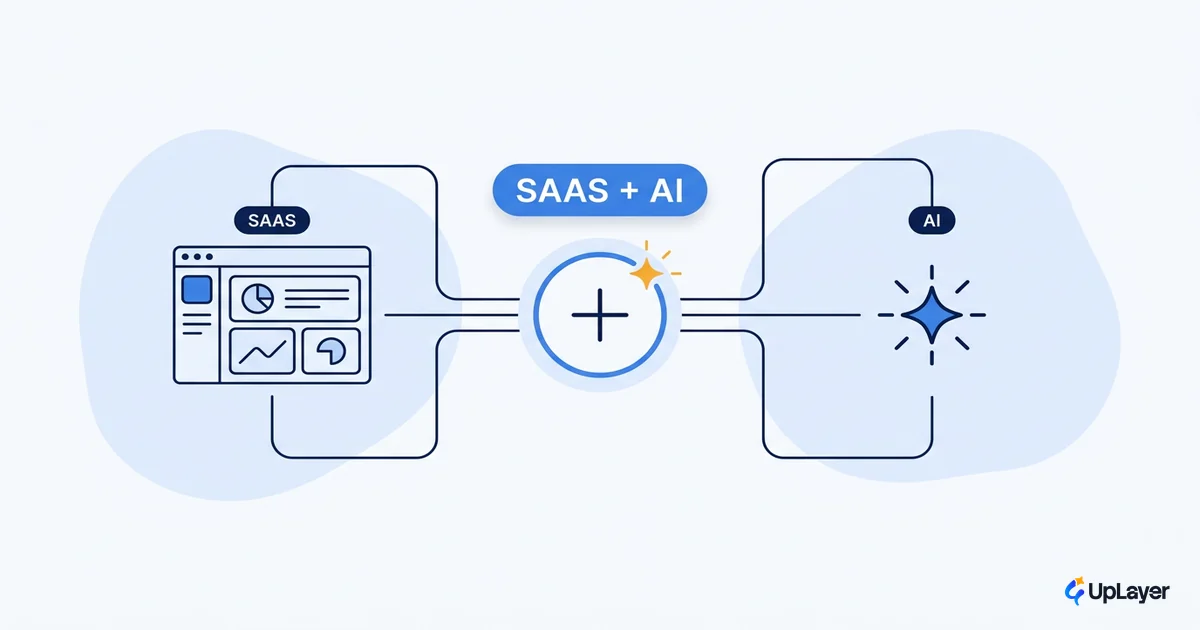
The headline has been clear for a year now. Pick a side. Software or models. Build a SaaS or get replaced by one. So you sit down to settle it, type "saas vs ai" into the search bar, and look for a verdict.
There isn't one, because the question is built wrong. The "vs" is the mistake. SaaS is how software gets delivered. AI is an input to that software. They do not sit on the same axis, so framing them as opponents is like asking whether you should choose electricity or the dishwasher. This piece covers why the versus framing is a category error, the layer model for how the two actually fit, and what that means for what you ship on top of the product you already own.
Why "SaaS vs AI" is the wrong question
There is no contest. The saas vs ai framing is a category error, because AI is an input that makes software more capable, not a competing category that replaces it.
The market data points the same way. In its State of the Cloud 2024 analysis, Bessemer studied its own portfolio of new AI-native vertical players against the legacy SaaS leaders in the same markets and found that these upstarts are mostly complementary to incumbent SaaS, not competing with it. The new applications lead with functionality the legacy product never had, sitting alongside it rather than displacing it. That is not two categories fighting for one seat. That is one category gaining a new layer.
"For the most part Vertical AI players are leading with functionality that is not competing with legacy SaaS. The utility of these applications is typically complementary to a legacy SaaS product." (Bessemer Venture Partners, State of the Cloud 2024)
The practical version of this for a founder is simpler. The question is never "do I become an AI company or stay a SaaS company." It is "which part of my product gets better with a model attached, and does that part move a number I care about." That is a decision about which AI features actually earn their place, not a decision about which team you are on.
Is it SaaS vs AI or SaaS plus AI?
The operator is wrong. It is +, not vs. The durable products treat AI as a layer that makes the existing workflow worth more, not as a rebuild that throws the workflow away.
Spending confirms where the value is accruing. Menlo Ventures reports that while foundation-model investment still dominates enterprise generative AI budgets, the application layer is now growing faster than the foundation-model layer. In the same survey, 60% of enterprise generative AI spend still came from one-time innovation budgets and 40% had already moved into permanent budgets. Buyers are not replacing their software stack with a model. They are paying more for software that uses a model well, and the spend lands in the application layer, which is to say the layer your product already lives in.
That reframes the whole exercise. You are not deciding between SaaS and AI. You are deciding where in your existing product an AI layer pays for itself.
Does AI compete with SaaS, or feed it?
Mostly it feeds it. AI substitutes for a thin feature here and there, but for a real product it is an ingredient that accelerates the metrics the product already moves.
The companies winning right now are not models pretending to be products. Sequoia's AI 50 analysis notes that application companies continue to dominate the list, and that large incumbents are integrating AI into their existing products to accelerate KPIs rather than getting replaced by a chat box. ServiceNow's AI assistant reaching case-avoidance rates near 20% is the pattern: an established product owns the workflow, and the model makes that workflow cheaper to run. The model did not win the customer. The product did, and then it added a layer.
There is a separate, sharper question hiding inside this one, which is whether AI actually kills SaaS by commoditizing the undefended parts. It does commoditize the thin wrappers. That teardown of "will ai kill saas" is worth reading on its own. But "what gets eaten" is a different question from "are SaaS and AI opponents," and the answer to the second is no. AI feeds the products that own a workflow and eats the ones that never did.
How do SaaS and AI fit together? The layer model
They fit as a stack, not a standoff. You keep the core engine you own and add supportive AI as a layer on top of it, where the model assists the workflow instead of becoming the workflow.
Here is the mental model, written as the relationship rather than the rivalry:
durable product = SaaS core  +  AI layer

  SaaS core   = the workflow you own
              + the proprietary data behind it
              + the integrations and trust you've earned

  AI layer    = a supportive feature on top
              + tied to one metric you already track
              + swappable, so a model change can't take the product down

  NOT: rip out the core and rebuild "AI-native" from zero
       (you'd trade a working business for a science project)
The difference between the two framings is the difference between a panic and a plan:
| Question | "vs" framing (the trap) | Layer framing (the move) |
|---|---|---|
| What is AI to my product? | A competitor that replaces it | An input that makes a feature better |
| What do I build? | A whole new AI-native product | One supportive layer on a metric I track |
| What's the risk? | Bet the company on a rewrite | Swap the model, keep the product running |
| How do I measure it? | Vibes and demos | Projected ROI on a number I already report |
| What do I do with "supportive ai"? | Treat it as a buzzword | Treat it as the lowest-risk way to ship |
The layer framing is what makes "the layer" a strategy instead of a slogan. The core stays yours. The model does the one job it is genuinely good at, on top.
What this means for an AI-native SaaS decision
If you have customers, revenue, and a working core, the ai native saas pitch to tear it all down and rebuild on a model is usually the wrong trade. Add a layer. Do not start over.
WARNING
The most expensive way to answer "saas vs ai" is to assume you must pick AI and rewrite a product that already works. A rebuild with no metric attached is the project that quietly dies after the demo. Keep the core that earns revenue and layer the model on top of it.
The lower-risk play is a supportive AI layer over the core engine you already own. If the model degrades or you change providers, the product still runs, because the engine underneath was never the model. That is the distinction the versus framing erases: going AI-native is one option, and for most established products it is the riskiest one, not the default.
Picking the one feature that earns its place
Settling saas vs ai in the abstract changes nothing on Monday. The work is to find the single feature where an AI layer moves a metric you already report, and to say no to the rest.
Start from the number, not the roadmap. Pick the metric you take to the board: activation, churn, expansion, time-to-value. Then ask which AI layer has a projected line to moving it, and which ones are theater. Most demo-friendly ideas will not survive that question, and cutting them is the point. The honest way to decide is to put a projected ROI on the one feature that moves your metric, then build only that one.
IMPORTANT
A quick test for any AI idea: remove the word "AI" from the pitch. If no one still asks for the feature, it was theater. The ones that survive without the buzzword are the ones worth a layer.
This is the discipline behind our 3X Guarantee: the audit finds AI worth at least three times its fee, or it is free. In a Concept Demo we frame every projected number as designed to move a specific metric, never as a result we have not yet earned.
So stop trying to win "saas vs ai" as a debate. It is a false fight, and the products that come out ahead over the next few years are the ones that treated AI as a layer on a workflow they already owned, tied to a number that already mattered. The question worth carrying forward is not which side wins. It is which single layer, on which single metric, is worth building on top of the product you have.
TIP
Not sure which layer pays off, or whether an AI feature moves a metric you already track? How the AX Audit works. We rank the opportunities by projected return and tell you what not to build.